
The previous post in this series explains the rule for tokens: NRFM. But what does this mean in practice? What sorts of tokens can be launched in Canada?
14 Legal Token Types
Native Units: The coin used by a blockchain for system-level transactions (i.e. not user-created tokens), where no return can come from management because it's truly decentralized. No management = NRFM.
Standard Tokens: An ERC-20 token (or Solana Token, etc.) with no special logic will generally not be a security in and of itself.
Free Tokens: Tokens that are given away for free are generally not securities because there's no investment by the recipient. No investment = no investment contract.
Meme Coins: Tokens that do nothing, and with no claims by the creator about it, do not have a return in any remotely financial sense. No return = NRFM.
Image NFTs: Non-fungible tokens that are a license to an image or other artistic work, and where the buyer receives the whole interest in something (usually an IP license), are hard to characterize as securities. In most cases these are just digital versions of artwork.
Fan Tokens: Tokens that have a community around them, branded by the creator, where benefits are in the nature of fan service are not typically going to have a return in any profit-minded/financial sense. Returns in the nature of feelings about a community, or attention from a celebrity, are not what investment laws are aimed at.
Loyalty Tokens: Tokens that do nothing, but have a business that will allow them to be cashed in for their services/products - these are the digital asset version of standard loyalty points.
Wrapped Tokens: Tokens that can be redeemed for a transfer on another chain are SEC/CFTC-blessed, and ought to not be securities in Canada but it is less clear than for other token types.
Liquid Staking Tokens: Tokens proportional to coins/tokens at risk in a technical staking systems, that can be redeemed for an underlying staked coin/token (similar to wrapped tokens conceptually), should not be securities because the thing they are for is not a security either. Typically there's no management in these either, so that would be the NRFM.
Fee Protocol Tokens: Tokens that earn a portion of the fees of a smart contract system are not under management control because actually decentralized. No management = NRFM.
Canadian Dollar Stablecoins: Tokens that can never earn a profit for their purchaser, and therefore have no reasonable expectation of profit from management's efforts, aren't securities but there is the new Stablecoin Act.
Store Credit Tokens: Canadian Tire Money is legal, and so is the digital asset version of it - the use of a token does not change the character of the thing.
Debt Tokens: Some smart contract systems for over-collateralized lending have an intermediate token (debt token) that may be bought, sold, or traded, and may even have a return attached to it as part of the larger debt system, but it isn't a return on investment from manager = NRFM.
Governance Tokens: Merely having a right to make votes about a decentralized system, or even a business, does not make something a security. Voting is often a part of shares, but it is also a part of many other things, and voting is just not a relevant consideration on its own. No return (and perhaps no management at all) = NRFM.
Securities In And Of Themselves
The above list of token types assumes that there isn't a surrounding investment scheme. As explained in prior posts; anything, whether orange groves, bags of silver, or condos can be turned into an investment scheme by a promoter. But this is a separate inquiry than whether the token itself is a security.
What Does Legal
Mean?
The above tokens should be ruled to not be securities by a court in Canada. That doesn't mean the OSC, AMF or another provincial securities regulator would like it, and there could be correspondence about it or even (probably misguided) enforcement action. Then, if reviewed/appealed, the securities regulator's decision would likely not stand, but this would be a long way off, and rather expensive to deal with.
I'm not oblivious to the expensive reality of dealing with provincial securities regulators, and have helped many clients with resolving them (all successful - without negative legal consequences for the founders). So anybody attempting to stake out their ground should do so in the manner least likely to attract securities regulatory interest, such as avoiding the words commonly associated with securities and generally following a more conservative path, where possible.
The golden age of tokens in Canada is not yet here, and it may take a bit of convincing by entrepreneurs.
US Views Have Evolved
Of the token types above, the SEC/CFTC explicitly mentions many of these as being allowed. The others can be inferred by analogy, but I am not channelling the US guidance with this list of legal token types. It is the underlying reasoning that leads to the conclusion, and since both Canada and America have the same general tests for what is a security, the reasoning carries across the border. And in fact, the Canadian securities laws are all derived from American laws, and were reformed under pressure from America. It is very likely that Canadian regulators will follow what US regulators have laid out for them.
What Does Illegal Mean With Smart Contracts?
In the case of a debt token, even if it actually is a security, if that's not being sold to anyone by management, what's the importance of it? It's an issue for the dealers that might want to trade in it, but so long as there's an AMM that'll work with it, or offshore exchanges, is that a problem? Some kinds of technically unlawful tokens may be unlawful in a way that's not legally relevant to the creators of the system. When working through these issues it's important to think about how the creators might run afoul of securities laws, and a lot less important to think about how users of a system might technically run afoul of those laws, because securities laws were not made to go after users of systems, they were meant to go after managers/promoters of investment systems.
Investment Systems
Investment systems/schemes/arrangements like in Howey and Pacific Coin are always subject to scrutiny as an investment contract. For example: a company sells a token and promises that in six months they'll make something great with the money, and the buyers of the token now will earn a profit from the money they put in now, because great things will happen with that money. The example would be worse if the company doing it spoke mostly about their team, advisors, and how they'll allocate the money to ensure the best result for the people who buy now. Estimating returns, or hyping up some reason for why gains will be made, and the buyers can cash out in six months? Even worse: they discuss it in the same way they would a capital raise, and refer to it internally as raising capital or getting investment?
There's always a point where a legal asset becomes part of an unlawful investment scheme, and token creators have to be mindful not to simply substitute a token for an investment raise. Raising capital is undoubtedly regulated in Ontario (and the other provinces.)
So What's Not Allowed?
It's generally difficult to construct a token, without a surrounding business system, that is a security. Where the token's smart contract has properties that provide a return, the return would have to be related to a larger system, run by management, because otherwise it's likely a technical feature of the system that is beyond the control of management. A properly constructed smart contract system, without managerial control on an ongoing basis, is likely outside the scope of the return on investment being from management (part 8). This is surprising for most people, who have heard that the problem is with the tokens. That's rarely the case.
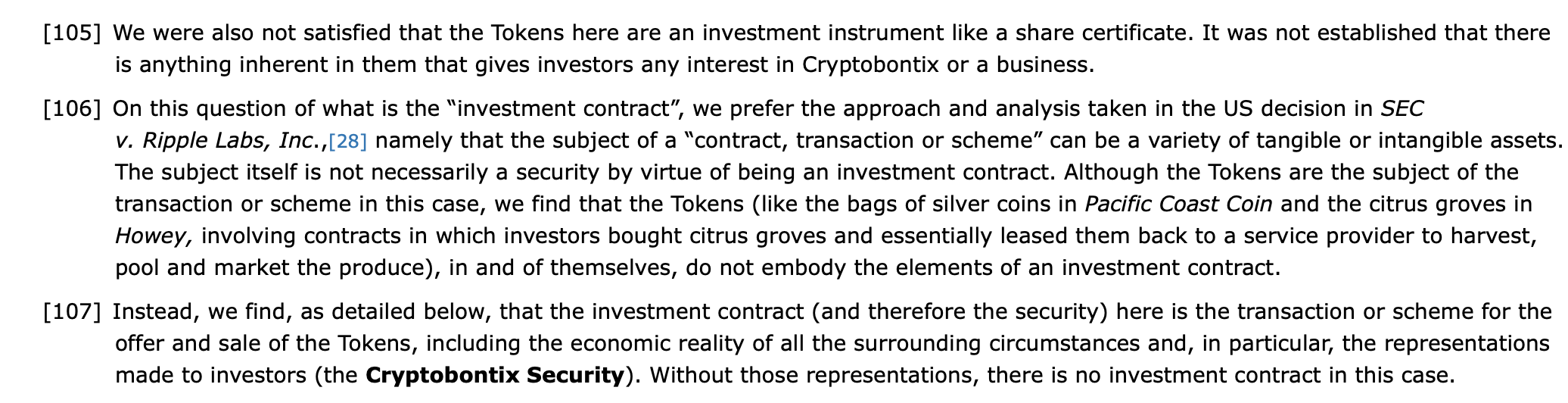
The vast majority of tokens actually don't have any special technical features or connection to any smart contract system, they're merely used within a larger business system created by management. This thinking can be found in the 2024 Hogg decision from the Capital Markets Tribunal at paragraph 105 (quoted below).
Why Not Use The Four Part Test From Howey?
Anyone who's been following the crypto securities debate for the last decade will be wondering why I don't advocate for simply
following the four part test of Howey as stated in Pacific Coin. The reason why is that it's impossible to understand, easily misapplied, and is not even the full basis of what a court might consider to qualify as an investment contract. The 2024 Hogg CMT decision points out the Risk Capital Approach
could be taken. All of this is really best to securities lawyers to debate. Businesspeople should instead think in terms of No Return On Investment From Management (NRFM), as explained in part eight.
Although there may be a degree of involvement by management in returns that may be acceptable, the point is that if this exists there is a securities law danger. It's not helpful for regular people to try to parse the decisions of courts without the benefit of reading the legislation and many other cases that help to understand what Pacific Coin decided. Canada has a number of great securities lawyers, who have lived and breathed this law for a large part of their professional career, and they know about crypto. Email me (addison@cameronhuff.com) and I'll send you some names.
Wrapped Tokens & Fee Protocol Tokens
It's worth pointing out that wrapped tokens and Fee Protocol Tokens are less obviously non-securities than other types of tokens. For Fee Protocol Tokens in particular, there's a heightened danger of being linked to an investment scheme, and anyone looking to launch one of these tokens will likely have to act more carefully than for some of the other token types. The surrounding circumstances of the sale of the tokens are likely to be the real issue, not the token itself.
Recap: What's Legal?
Most tokens are legal, as tokens. Some tokens may be enmeshed in unlawful schemes to raise capital without following the rules for raising capital. The next post in this series takes a closer look at the methods of sale and how that impacts the investment contract concept which may make a token sale prohibited even where the token itself isn't a security.