
I've analysed the 1662 companies registered with the Bank of Canada under the RPAA. This is the most complete sets of statistics you'll find anywhere about what's going on with the RPAA in Canada.
85% Canadian Corporations or 50% Canadian Corporations?
85% of registrants are Canadian companies. Of the other countries that had more than one registrant, the graph below shows the breakdown. By far the largest is the United States, as expected, with Great Britain in a firm second place.
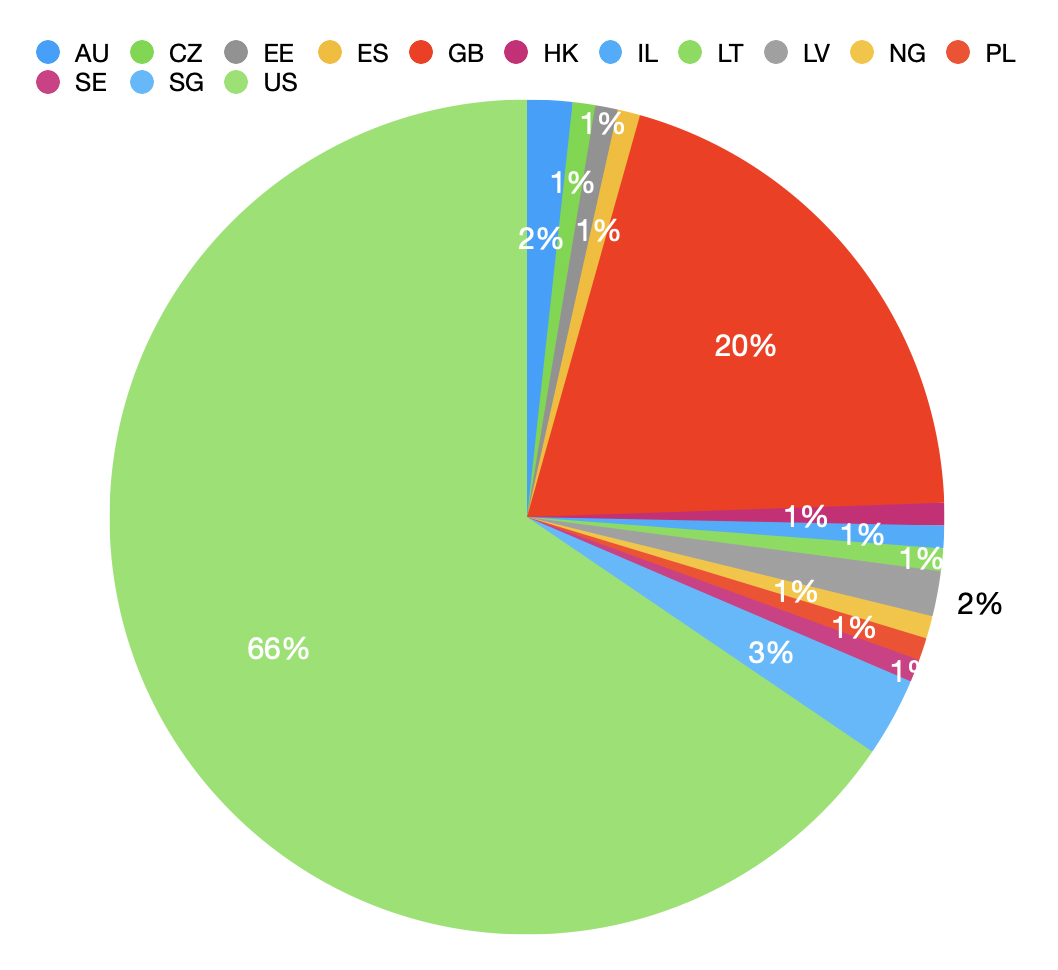
But the RPAA registrants are not 85% Canadian, despite what the registry says. The data is a misleading picture because many of the "Canadian" companies are subsidiaries of foreign companies. There are 38 registrants that are Canadian corporations that list UK phone numbers for their contact information.
Approximately half of the registrants are using Canadian phone numbers. Does that mean that the other half are foreign businesses? No, because some Canadian companies are using 1800 numbers or American numbers but they're actually not a subsidiary of an American company. That said, certainly many of the companies that are registrants are subsidiaries, so the actual number of "Canadian" comapnies that are registered is much less than it appears to be. This makes sense given the fairly open nature of the fintech market in Canada (as opposed to the banking/trust company market, which is largely closed to foreign companies).
What Cities Are Fintechs Based In? Toronto > Vancouver > Montreal
Of the companies with phone numbers that are Canadian city area codes (about half of them), it's not surprising to see Toronto is #1 with 315 (and 51 more in Mississauga). Vancouver is second with 161. Ottawa and Montreal are tied at about 70 each. It's a bit surprising that Vancouver would have twice as many as Montreal and Ottawa but this is the same pattern that's seen in the MSB registry. Vancouver has a lot of MSBs (many of them serve the Asia/Canada connection market). So this probably doesn't reflect Vancouver's dominance in the fintech space so much as it reflects the wide scope of the RPAA, which captures many MSBs.
Duplicate Addresses: Duplicate Registrants?
As with the MSB registry in Canada, there are many companies with the same registered office address. Sometimes that's a law firm address, sometimes it's a virtual office, and sometimes it's an indication that there's several registrants that are related.
The most popular (and mysterious) address is 104-1907 Baseline Rd. in Ottawa. Many fintechs are using this address but it doesn't seem to be a law office or a virtual address.
An incorporation service in Mississauga is the second-most used address. The third-most common address is a virtual address in Vancouver. A Regus office at 100 King St. W. in Toronto is also popular. Bennett Jones (in the same building at 100 King St. W.) seems to be the most commonly used law firm mailing address. This isn't surprising given that many fintechs either don't have an office or don't want people visiting their office.
400 Shell Companies?
About 400 of the registrants don't appear to have an online presence that ChatGPT was able to find. That doesn't mean they don't have an online presence, but in my spot checks this seems to be approximately correct. It's a bit surprising that about 1/4 of the registsry is companies with no online presence, considering the nature of the law under which they're registered.
Different Payment Functions
The RPAA has a concept of "payment functions" (which trigger the application of the law) and not every registrant has the same set of payment functions. Here's the breakdown:
1282 Authorization or Transmission, Reception or Facilitation of an instruction in relation to an electronic funds transfer
1209 The initiation of an electronic funds transfer at the request of an end user
960 The provision or maintenance of an account that, in relation to an electronic funds transfer, is held on behalf of one or more end users
761 Holding of funds on behalf of an end user until they are withdrawn by the end user or transferred to another individual or entity
390 Clearing or settlement services
Unusual Types Of Businesses
The RPAA is a wide-ranging law that probably captures more businesses than its drafters intended. So it's interesting to see what sorts of businesses are captured. I used an LLM to provide one-line summaries of the businesses based on their websites, which worked for many of them. Here are some of the interesting highlights for businesses that might not seem like the focus of the law:
"Advisory services including payment functions and funds management"
"Cloud-based accounting software for small and medium-sized businesses"
"Cloud-based finance and IT solutions for treasury and risk management"
"Connecting students with companies for project-based learning experiences"
"Convenient parking solutions and payments via mobile app"
"Event ticket marketplace and resale platform"
"Family support and counseling services"
"Provider of mission-critical software solutions"
"Provides ERP software solutions"
"Software services for fitness and wellness businesses"
Teranet caught my eye (the Ontario land registry system): "Provider of land registry services and electronic funds transfer facilitation."
Poshmark, the online clothing marketplace is also listed: "Social marketplace for buying and selling new and secondhand fashion." There's also a Walmart entity named "WM BILLING SETTLEMENT NAV CA, ULC".
SkipTheDishes and Ritual, the food delivery companies, are both listed but Uber Eats is not.
There's also a variety of specialty payment processing companies, such as one for gyms, another for "faith-based organizations" and one for parking. Fintechs come in all shapes and sizes!
Missing Registrants?
If Poshmark and SkipTheDishes determined that they need to register, where are the other clothing marketplaces? Undoubtedly many more companies will discover that they need to be registered with the Bank of Canada.
Multiple Registrants
One of the easiest ways to spot multiple companies in the same corporate group are that they reuse an email address. For example, one company controlled from the US has two companies in Canada and two in the United States.
There's even two (seemingly unrelated) companies that have the same domain name, which is for a company advertising RPAA registration services: https://setupmyfintech.com. They offer "Acquire Ready-Made MSB" as a service and "Fintech and Crypto Business model advisory". There are three companies that are registered to their office address.
Renno & Co, a law firm active in this space, has seven registrations using emails tied to them but customized to the client name. Undoubtedly they have other clients that are registered but this is one that stands out because of the pattern of companyname@rennoco.com. Several other law firm emails are being used too.
Individual Registrants
The RPAA does contemplate an individual being registered but it's still surprising to see there are a few. And there's a few registrants that are using clearly residential addresses (which is a security risk for them).
Obscured Company Names
"Sold through Link, LLC" is Stripe's entity that's registered. There are definitely a few companies operating in a similar manner. There's nothing nefarious about this, and they have their general website (stripe.com) listed in the registry, but it's interesting to see as one scrolls through the list. Other companies have more obviously-related names.
Relatively Good Quality Data
The data in the RPAA registry is pretty good but it probably isn't being validated by the Bank of Canada.
There are many address errors (wrong postal code, wrong city, and missing unit numbers) which the Bank of Canada should probably fix up. If they confirmed address by sending mail to them, like Google Maps, it would help to ensure the integrity of the system.
Quite a few companies are missing phone numbers, which seems like a bit of an oversight given the focus on consumer protection in the RPAA. There's also few obvious shell companies than in the MSB registry. But probably someone at the Bank of Canada should look into the multiple registrants sharing phone numbers and email addresses to find out what their relationships are with one another. They should also look into the registrant who listed their phone number as "1111111111".
The 41 Companies Registered With The Same Ottawa Phone Number
There's an Ottawa phone number that's used by 41 different registrants. It's not a law firm's number because it's used by at least one major company that's surely unrelated to the other registrants. Odder still, at least two different law firms are using the same number. I called the number and it's a voice call back service but how would it know who to route to? This is probably a mistake someone has made, but it's been repeated across many companies - strange. There's at least one company that's probably not going to be receiving any phone calls...
Overall Sense
The RPAA registry data looks about how someone would expect but with a greater focus on foreign-run businesses than I expected. It's also interesting to see how many companies are related either directly through a group of companies or indirectly through the same consultants/lawyers. That said, I expected to find a pattern of law firm addresses that I don't see in the data. Perhaps large law firms aren't well-represented in the data because the clients that can afford to hire them can also afford their own address.