
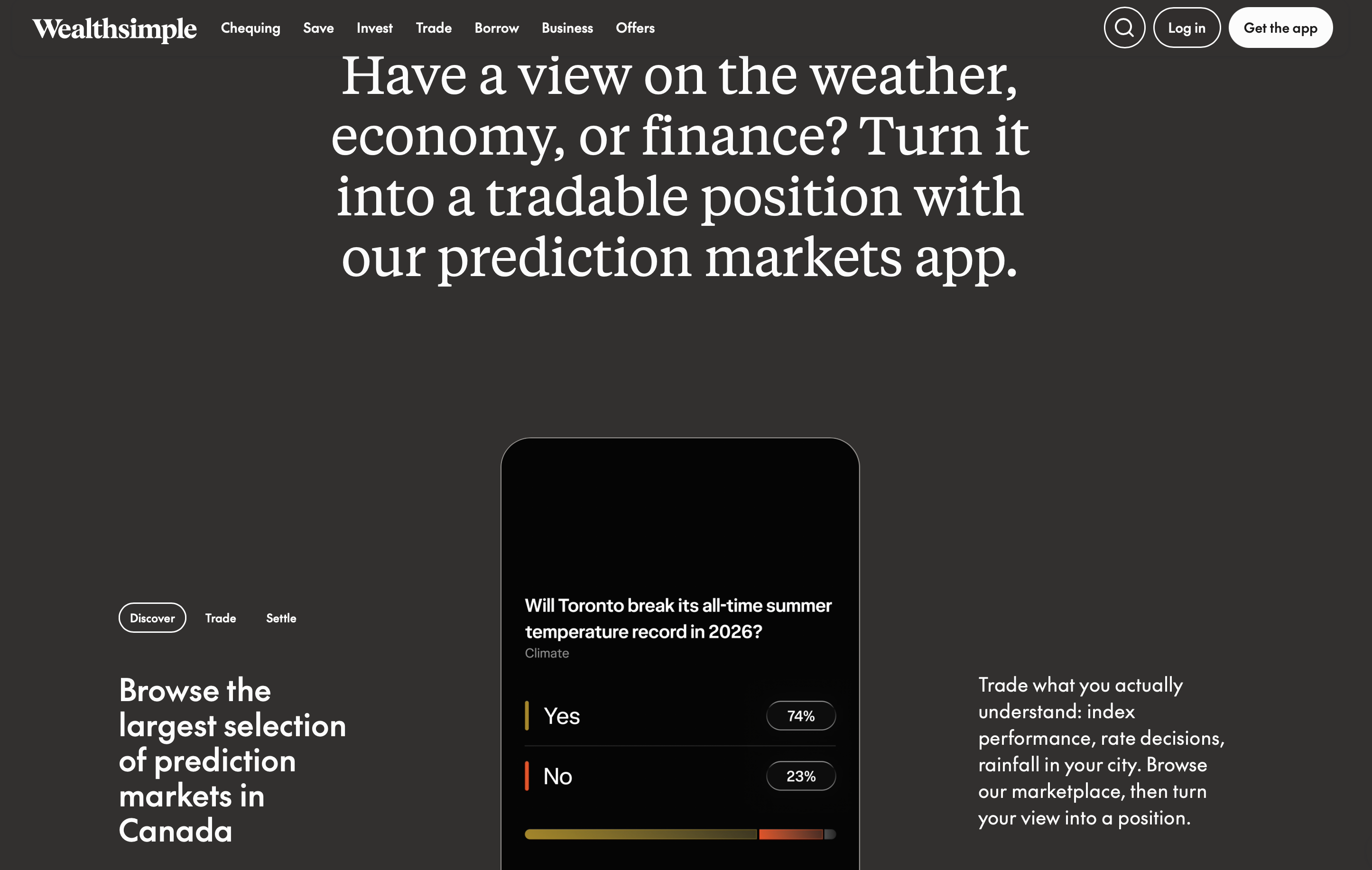
I recently wrote about the "SuperApp" for Canada. One of the big legs: prediction markets. This has become a hot topic with the rapid rise of Polymarket and Kalshi. In Canada, Wealthsimple's "event contract" trading product became available in the summer. So what's the law about this? What can businesses do in Canada?
Gambling vs. Securities Trading vs. Crypto Markets
There are three big viewpoints for prediction markets:
1. Gambling
2. Securities/derivatives trading
3. Blockchain-based systems
Gambling: Sports Gambling
One type of prediction market is gambling. The most popular kind is sports betting, where people try to bet on the outcomes of games or parts of games. This is a licensed industry. In Ontario, this is overseen by iGaming Ontario, which has a comprehensive licensing system for this type of "prediction market". There are similar provincial regulators elsewhere, and all of these provide cover under s. 207(1) of the Criminal Code of Canada. Operating a gambling business without a license is otherwise criminally illegal. But does fantasy football count? This has been the source of enormous amounts of litigation in the United States. Both Fanduel and Draft Kings operate licensed gambling businesses in Canada that offer this.
There are edges to the box that "gambling" fits into in Canada that might permit certain types of unusual prediction markets (see below, in the section about blockchain-based systems), but the operation of a casino is certainly regulated at the federal level criminally and at the provincial level in terms of gambling licenses. That said, there is a border where this crosses over into securities/derivatives trading (which can in many cases looks like gambling).
Securities/Derivative Trading: "Events Contracts"
Wealthsimple Predict is authorized to trade in certain (limited) events contracts according to an Administrative Bulletin published in March by CIRO (one of the regulators of securities dealers). The bulletin limits trading to three types of contracts:
"Economic Forecasts: such as contracts based on economic statistics related to the amount of sovereign debt, inflation rates, central bank reserve rates, labor markets, and housing;
Environment Forecasts: such as contracts based on climate indicators related to the average global temperature;
Financial indicators: such as US 500 Forecast Contracts that settle based on the daily settlement price of the Chicago Mercantile Exchange (“CME”) E-Mini S&P 500 Futures."
The maturity date for the contract has to be at least 30 days or longer, and they must be "traded and cleared through certain U.S. regulated exchanges and clearing houses".
Despite the closed list of categories that are permitted, CIRO also specifically forbids:
"event contracts based on the outcome of elections, political events, or other events of a political nature such as contracts predicting election results, political party leaders' nominations or referendum results or otherwise offer event contracts based on the outcome of unlawful activities under Canadian federal, provincial or territorial law."
Prediction markets of this type can't go beyond the above guardrails but the provincial securities regulators (together with CIRO) have provided written guidance that notes that the vague boundary between events contracts and gambling (or other regulated areas):
"In some cases, the characterization of these products and other applicable facts and circumstances may raise questions as to whether they fall within the scope of securities or derivatives legislation1, or may fall within another regulatory framework applicable in Canadian provinces or territories."
The August 27th guidance from CIRO/CSA clarifies that they don't think sports gambling can fit within events contracts: "sports and entertainment events or outcomes should not be regulated within securities and derivatives legislation". They also note that MI 91-102 prohibits binary options trading in Canada (where there's a maturity length of less than 30 days). Polymarket settled with the OSC in March of 2025 for offering short-dated binary options in Ontario.
What the August guidance implies is more important than what it says. The provincial regulators are telegraphing that they won't allow products like Wealthsimple Predict to expand beyond the approval they've been given.
Blockchain-Based Systems: The Alternative
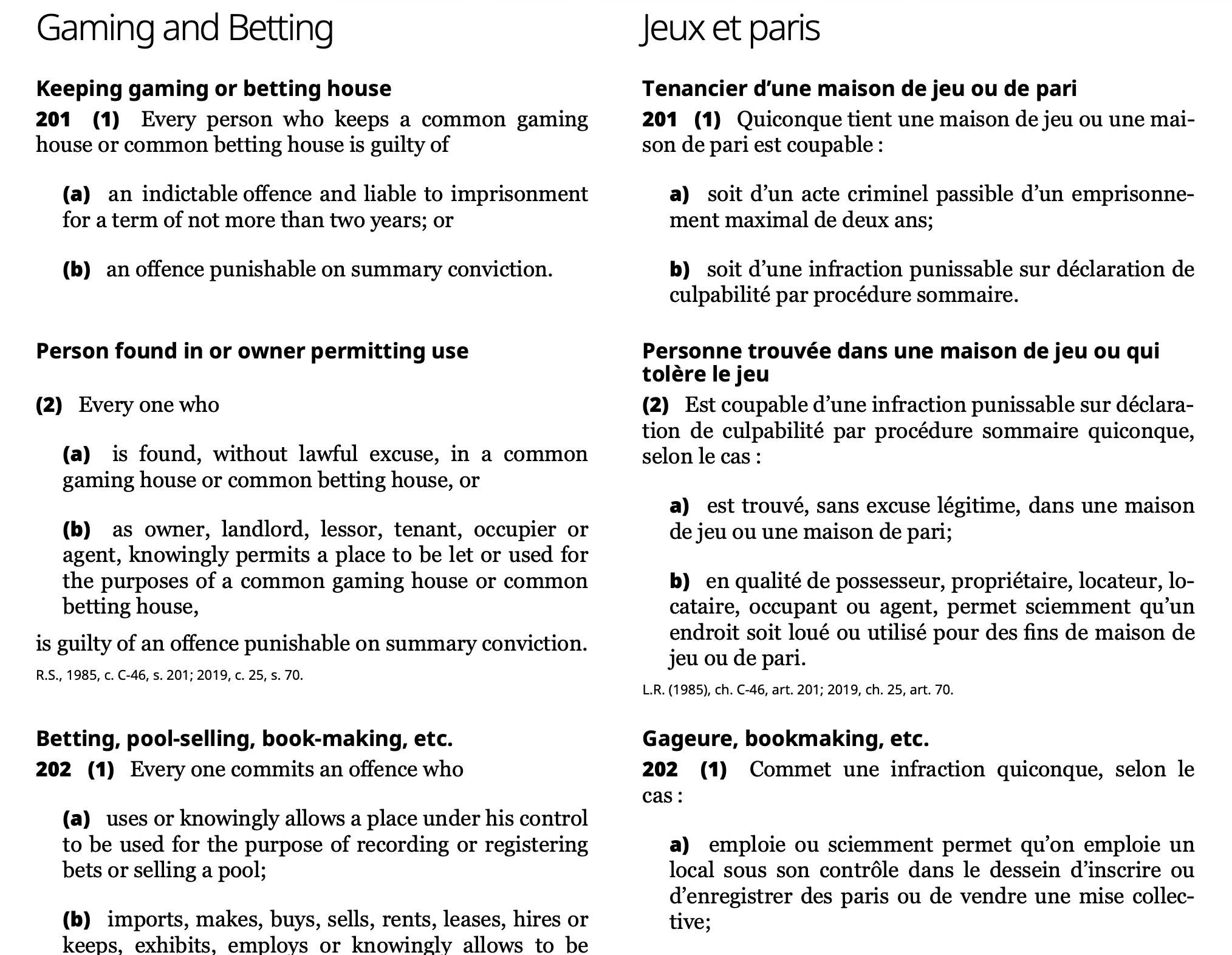
The core concept of the legality of blockchain-based systems is that the users do it themselves. Because a company doesn't do it there's very often no applicable regulatory regime, since most statutory schemes target companies that intermediate controlled activities. For example: s. 204(1)(b) of the Criminal Code expressly exempts "a private bet between individuals not engaged in any way in the business of betting" from the ss. 201/202 prohibitions (i.e. betting houses, betting pools, etc.).
This pattern repeats in other areas, but usually without the specific exemption - it's simply not covered. In some cases, these rules can even function as "loopholes" like Airbnb and Uber, which both claim to not be the providers of hotel rooms or taxi rides, since they say that these activities are happening directly between users within their market. The case for blockchain systems is even stronger because they're typically not intermediating payments and other activities. The key is that the users do it directly.
One reason why laws don't target user activities is that the person has traditionally been seen as the "victim" of illegal business activities. For example, securities laws target the issuers and dealers of unlawful securities but not the buyers. Anti-money laundering laws target the businesses that facilitate money movements but leave the unlawful movement of money to the police. If a person goes to a currency exchange shop to get a foreign currency, and the business doesn't create the proper records, that's almost always a problem for the business and not the customer, even if the customer went to that forex business because they knew about that compliance problem.
Blockchain systems have done well from a regulatory perspective because they can be arranged such that actions are almost entirely peer-to-peer, just like the networks themselves. So there's two layers: the actual transactions are being sent and incorporated in a decentralized way (into blockchains, that are formed from blocks of transactions) and then there's an application layer above that which allows for some sort of activity. One example: on-chain betting.
Unstoppable Betting: User Interfaces
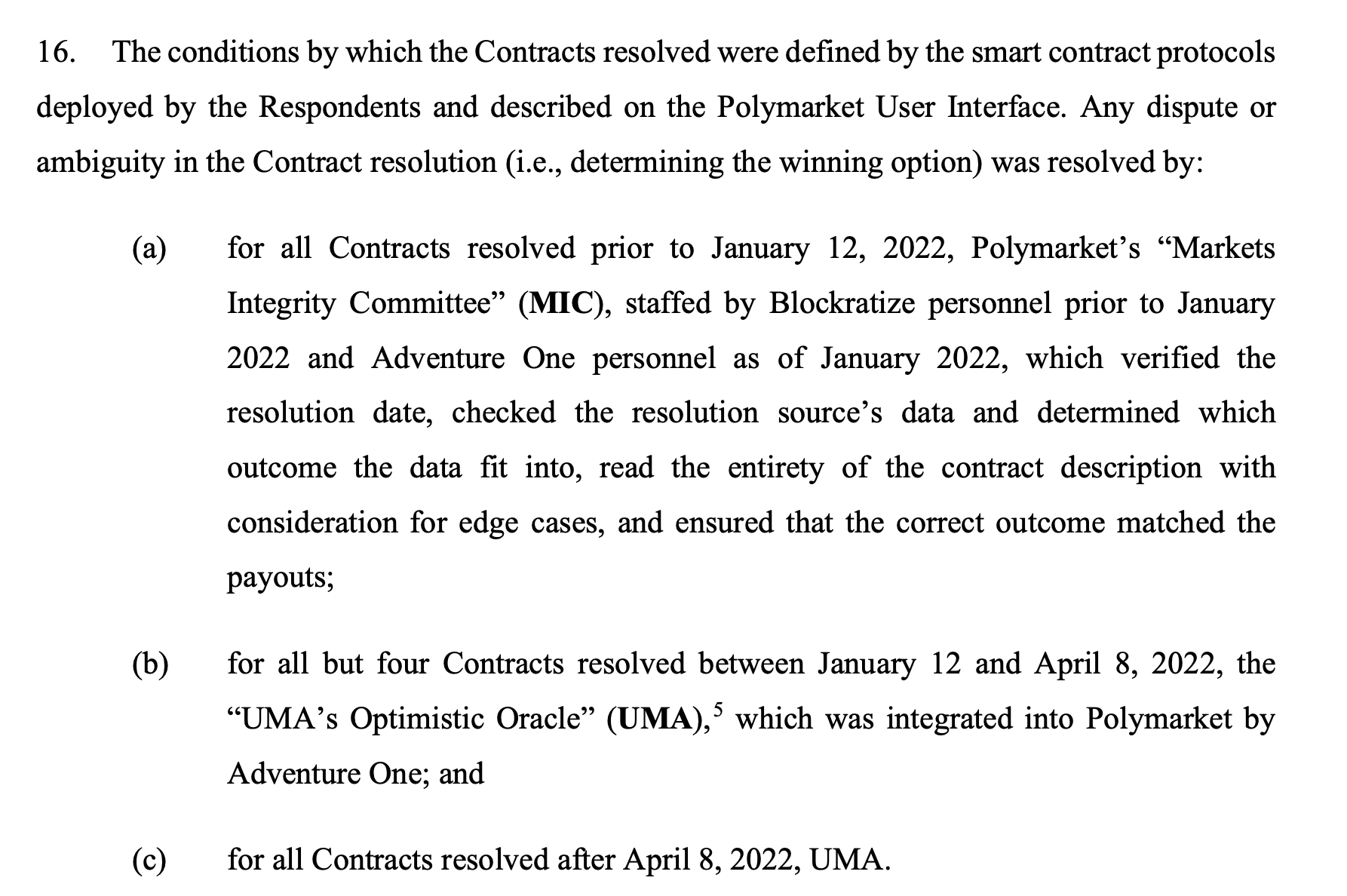
Once a gambling system is encoded into a smart contract it becomes (potentially) unstoppable. Not just legally but technically. There are Ethereum programs that have been running for years that no one can stop or affect. So the only real lever is to target the user interfaces that make them easy to use. Since these systems are always the second layer (above the blockchain itself), it's often much more convenient to access through a user interface rather than a wallet or some sort of command line. There aren't really generic tools for blockchain UIs yet, so there's typically a website to target, and it's often run by the people who made the gambling/prediction service in the first place. This has been the angle for targetting Polymarket (event prediction), Uniswap (decentralized trading, sometimes of securities), and many other services.
Blockchain Systems: The Browser Analogy
User interfaces are potentially vulnerable, but what of true third parties that build wallet-like systems to connect to them? At a certain point the closest analogy is not to a casino but instead to a web browser. Some wallets are so generic in their functionality that they can't be considered to be a part of the unlawful system. For example, the Coinbase Wallet allows users to hold and transfer any Ethereum token using standard user-controlled private key methods. The Coinbase Wallet is a generic tool that can be used for transferring tokens that are securities (a non-blockchain legal interpretation of the subject matter) just as easily as the vast majority of tokens which aren't securities. It's akin to a web browser which makes no judgement of the websites that are visited (but with even less knowledge of the contents).
Event prediction and gambling are applications that people want and at some point they'll be entirely or almost-entirely on-chain (someone needs to supply the data about winners and losers to connect the real world to the system but this can be decentralized in various ways too). This is an inevitability, and there's already many examples of this. Cryptocurrency itself can in one sense often be considered gambling, and the memecoin space is even closer to that concept of random price movements.
The Future Of Gambling & Prediction Markets
The world is full of laws about gambling and prediction markets but to the extent that these laws stop punters from doing what they want the users will migrate to on-chain solutions that allow them to access the greater universe of global betting/predicting. The question for regulators is at what point is their domain transgressed by a blockchain interface? Is a user-controlled wallet suddenly offside of gambling or securities laws when it makes it more convenient to interact with specific smart contracts? Does supplying data or information to the user step over the line?
The opportunity for platforms is to extend to their users the benefit of the wider world of services by offering blockchain connectors. If a user moves their money out of the walled garden and into the user-controlled wallet space (e.g. Coinbase Wallet) then they should be able to access the wider world. Exactly where the boundaries are with this will be litigated in the years to come, and it's a matter of risk tolerance/narrative, but there's a safe space somewhere. The lines will be drawn differently in different jurisdictions. In Canada, regulators will have to grapple with the boundaries of securities/derivatives, and with the boundaries of gambling. Instead of running casinos or sports books, entrepreneurs will turn to software and consider how to make systems that don't just serve Canadians but instead can serve the entire world, on-chain. And the regulated platforms will see this and wonder how they can let people escape the sandbox. Users will benefit from the lower fees and better odds that come with global liquidity vs. local markets and local regulated company fees (casinos aren't free to run).
My prediction: the law of prediction markets will become the law of what a software developer can do in terms of integrations with global on-chain services. This is a general question of law, but it's also a specific regulatory question because each regulator will deal with the implications differently.