
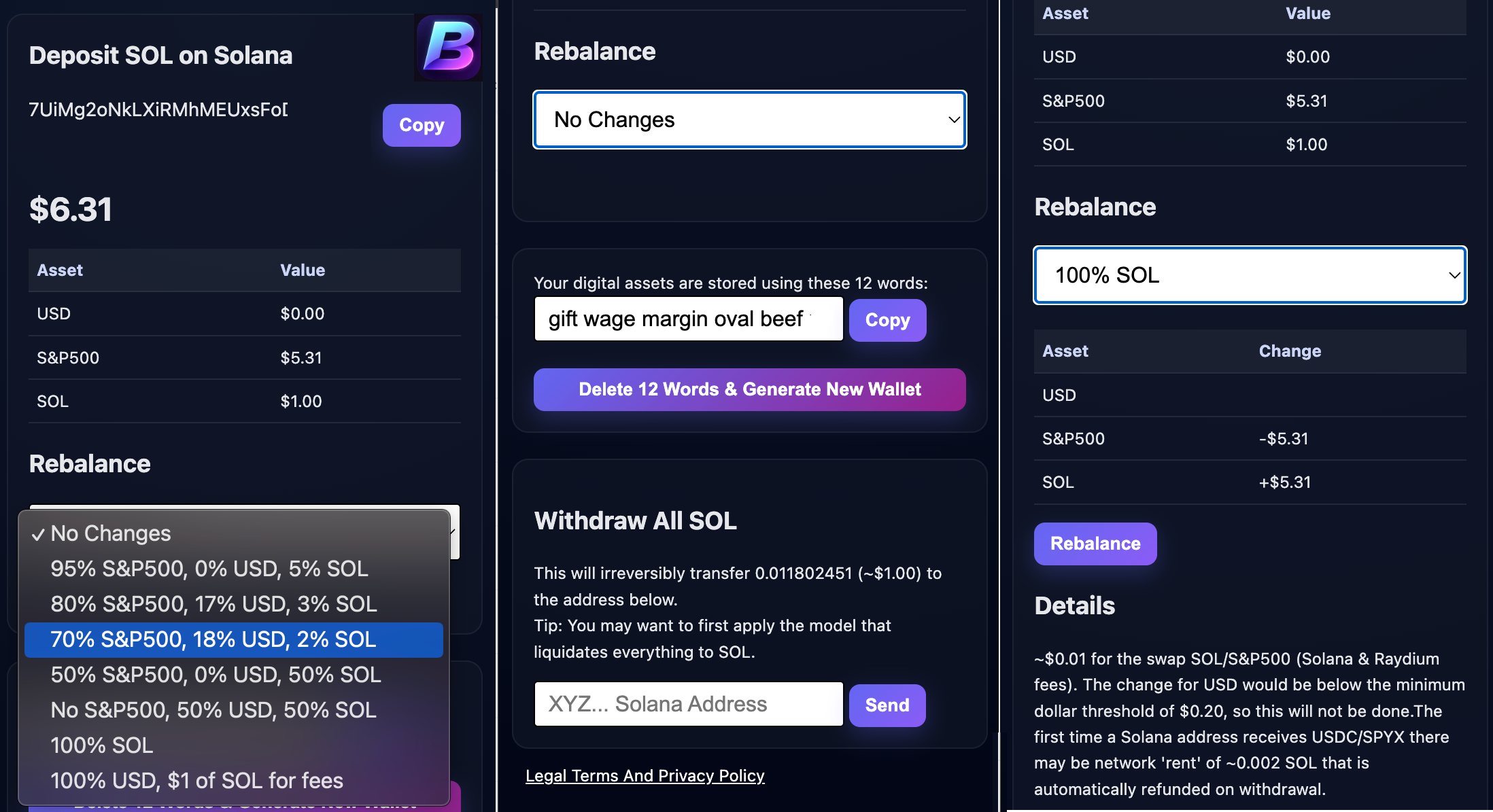
On Monday, I posted about Bask Wallet
, a crypto wallet I made that demonstrates the coming future of on-chain finance. Why is this interesting? What does this say about what's coming?
This post discusses the idea of a Starbucks app with Starbucks stock rewards, the tokenized McDonald's stock available right now on DEXs, future tokenized equity for smaller companies, the technology vs. regulation battle, taxation of securities gains, and other implications that the Bask Wallet demonstrates.
What's Interesting
I made Bask Wallet as a solo developer, in my spare time, in a matter of weeks. Wallets have become easy to develop and the infrastructure the supports them, such as RPC nodes, libraries, and DEXs, are easily accessible. This isn't a story about AI, although LLMs are useful for debugging (but I did not find it useful for designing the code or writing it, for the most part). This is a story about the tooling improving, and the ecosystems maturing. There's a lot of talk in crypto circles about the billions burned on tech development in past years, but the money wasn't really burned, it was used to lay the groundwork for the next phase.
What's Coming: Starbucks App With Starbucks Stock
Stock trading can now be done on-chain. People can trade individual stocks, and it's entirely possible that in the future we'll see a Starbucks app that lets you store your gift card money in Starbucks stock, or earns you Starbucks stock as rewards. If this is done in the context of a user-controlled wallet, and with the right regulatory/commercial approach, it would be lawful right now for Starbucks to do this. And the technology allows it.
xStocks, the maker of the SPYx (S&P500 token) that Bask Wallet uses, has about 60 stocks currently tokenized. Starbucks isn't one of them, but McDonald's is. Below is a screenshot of the McDonald's token, trading on Solana, right now. This is real, and the value very closely tracks the market value.
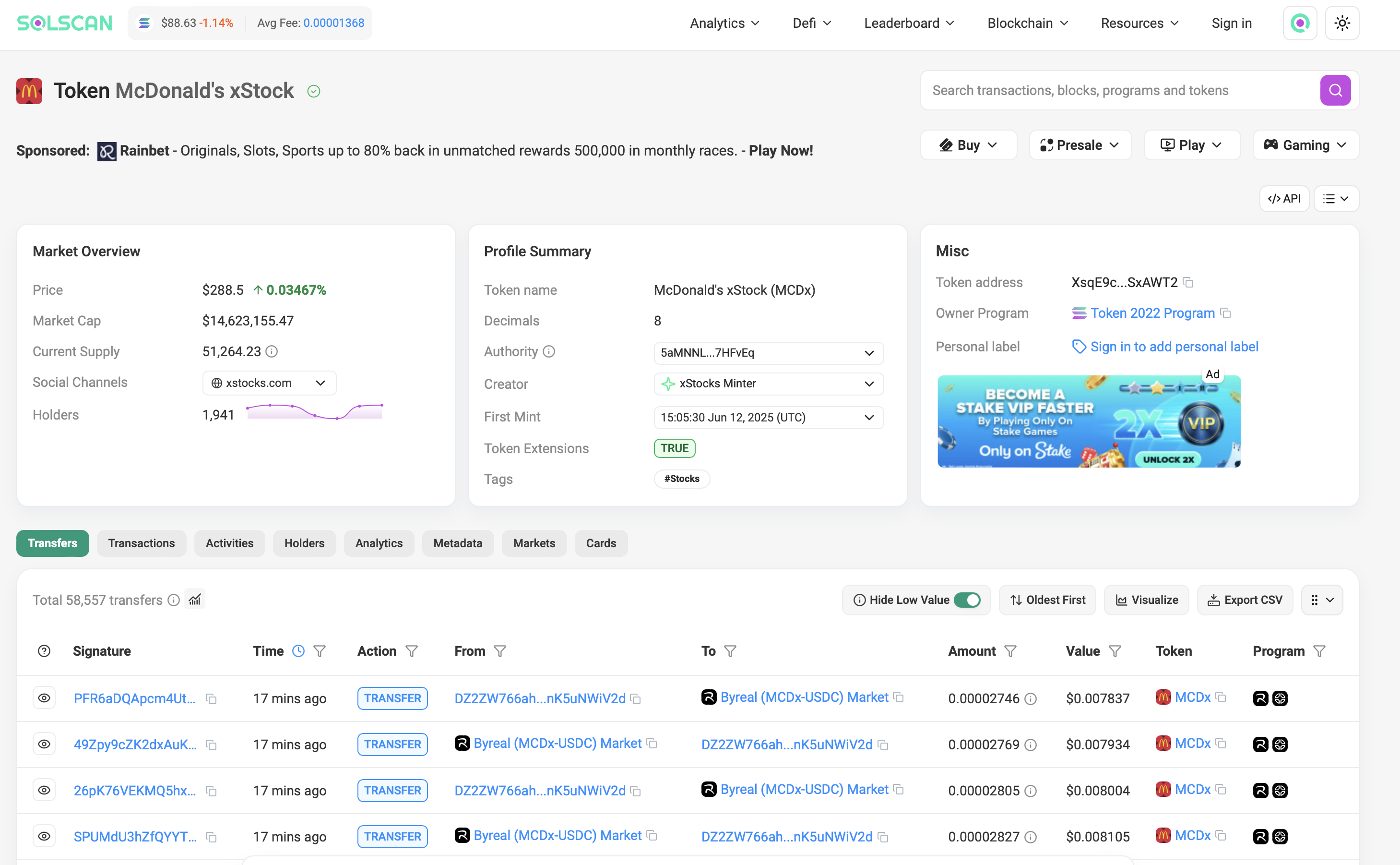
My example of Starbucks is what's coming, but someone could actually make the McDonald's example app right now, and have a loyalty system that pays out in crypto to the user, which then can be used with a DEX to buy the tokens. Or, go even further, people can place leveraged bets on McDonald's stock, which exists right now on Byreal (ByBit's perps market).
McDonald's doesn't want their McD app to be used to make leveraged bets on their stock, but maybe in the distant future they won't have a choice, as that'll become standard. People love giveaways and the chance to win a lot of money on McDonald's scratch games on containers of fries. Is it a big leap to making bets with loyalty points? Yes. It is! But where the technology exists, the applications follow, and what seems like a wild idea today may become a part of normal life. There's more and more high risk betting happening in society, and an acceptance of strange financial products like zero-day options that were once reserved for only the bravest of professional traders in the 1980s. Today? That's a regular person trading from their phone on the way to work.
The Tokenized Path For Companies
McDonald's has no say in the xStocks tokenized version of their equity, but they probably aren't opposed to it. Most companies want liquidity in their stock, and smaller companies even pay market makers to deliver liquidity to their stockholders. Is it a stretch to think that some companies will start promoting their stocks directly to customers? That's been forbidden by law (essentially) for many decades, but thanks to the new means of tokenizing stocks (explained in my September post on the subject), this is just something that's reality. Where it exists, it will be embraced. By McDonald's? Probably not. But Tesla is also an xStock that's available on DEXs. Will convention really hold back Elon Musk from doing something like this with Twitter?
As the tokenized pathways become easier, probably smaller companies will end up having their equity tokenized too, to expand to foreign markets. Currently, that's an expensive prospect. But with tokenized equity it becomes a technology process, not a regulatory process. That's a massive change.
Going back to the start of this post; we're at the point where a lawyer in Canada can make an app in a few weekends for people to buy and sell dozens of stocks, without a regulatory license, and without having any control over the process. Bask Wallet is fully decentralized, in that there's no backend application that controls it and users fully control their assets, transactions, and what they do. This is a brand new world for investments.
Technological Change vs. Regulatory Processes
One way this goes is that users will gravitate towards the largest companies, which have the best regulatory coverage (i.e. first world countries with good securities regulators). The liquidity, supervision, and brand names, may lead to an entrenchment of the biggest companies. Which may ultimately lead to a reduction in the workload of securities regulators, who can now concentrate on the big fish.
Another future for this is that stock market reguators become less relevant, as the main action will be happening outside of supervised platforms, on DEXs (decentralized exchanges). The DEXs will eventually converge on near-zero fees due to competition, and they'll also converage on offshore locations, because those are the cheapest to operate in. This would be a major change in the role of securities regulators, who may be forced to provide a registration/supervision role that's divorced from the market side. It would also change the dynamic of supervising brokerages, because more and more activity will shift to the on-chain world.
Technological Change vs. Taxes
Taxes are increasing globally, in just about every country. Aging populations demand greater and greater benefits, while a smaller workforce is taxed to pay for them. There's a basic demographics problem for most first world countries, combined with decades of political decisions that have entrenched an upward movement of tax rates, that is leading to new proposals to tax securities. For example, the unrealized capital gains tax recently passed then rescinded by the Dutch parliament. People may switch to on-chain financial products to opt out of the taxes that they oppose.
On-chain stocks and ETFs can be done in a way that's untrackable by tax authorities. Currently, most people aren't taking the steps needed to obscure their trails on-chain, but in the future that may change as part of the movement towards on-chain versions of securities. Not everyone loves paying taxes, and when given a technological means of not paying them, at least some people will do that. As the technology becomes easier, more and more people will choose to do it.
In one way, this is a return to the voluntary nature of tax forms. Tax residents are required to report transactions they conduct in cash or by barter. But tax authorities know that some people don't report, which is why the focus of tax authorities and governments in all countries has been to use digital technology to create tax traces that expose all transactions. That's why cash is being effectively banned for commerce. That's why identification is required for more and more accounts. That's why there's more forms generated and more systems to tie into. That's why Quebec requires that restaurant receipt printers generate electronic records that are sent to them monthly. Digital systems have been a boon to tax authorities as they seek to collect every dollar that they're authorized to collect. But digital systems can also be made that don't work like this. Crypto systems are generally global, and they're not made to account for Quebec's views on taxes, or any other place. And they may be set up to make it essentially impossible to collect taxes on anything other than what is reported voluntarily.
True, the entry and exit points of crypto are usually regulated and can be tracked. It's not obvious how this technological battle will play out. But the point isn't whether everyone in the future won't pay taxes on securities trades, it's that there's now a technological system that makes the answer different for at least some people. That's not currently the case with domestic securities trading, which in almost every country is electronically tagged and reported to the government automatically.
What Other Implications Are There?
People who trade stocks right now have to use the service their broker makes. Perhaps in the future they'll have a much wider choice of apps, because they won't be locked to their domestic brokerage apps. They'll have a universe of different wallets to pick from, made by development teams all over the world.
New apps mean new possibilities. In Bask Wallet, the user is given a way to switch between model portfolios in two seconds, for ~$0. There's no stock trading app in Canada that permits this, because the government doesn't allow brokerages to provide that to regular people. New apps mean new trading possibilities.
Bask Wallet Is An Example
My wallet, Bask Wallet, is available in the Chrome Web Store (although I made it private, so only selected people can try it out). App stores will allow these kinds of applications. And right now, people can download all kinds of crypto wallets that permit buying and selling any token, which means tokenized securities tokens too. They fit into the same technological box as non-securities, and the DEXs generally don't care what the regulatory status of the tokens is. In some cases, the DEXs actually can't stop people from trading these tokens, because the smart contracts are immutable and will accept any token that's inputted into the system.
This is not going away. Yes, it's very early days. This is still an unusual technology. That's part of the reason why I built Bask Wallet - to see what the future will be, because it's not quite here yet. But the elements are in place, and even hobbyists can make these kinds of products. That's a significant shift for securities markets that will soon be noticed by industry as a massive change that's gone relatively unnoticed.
You saw it here first.