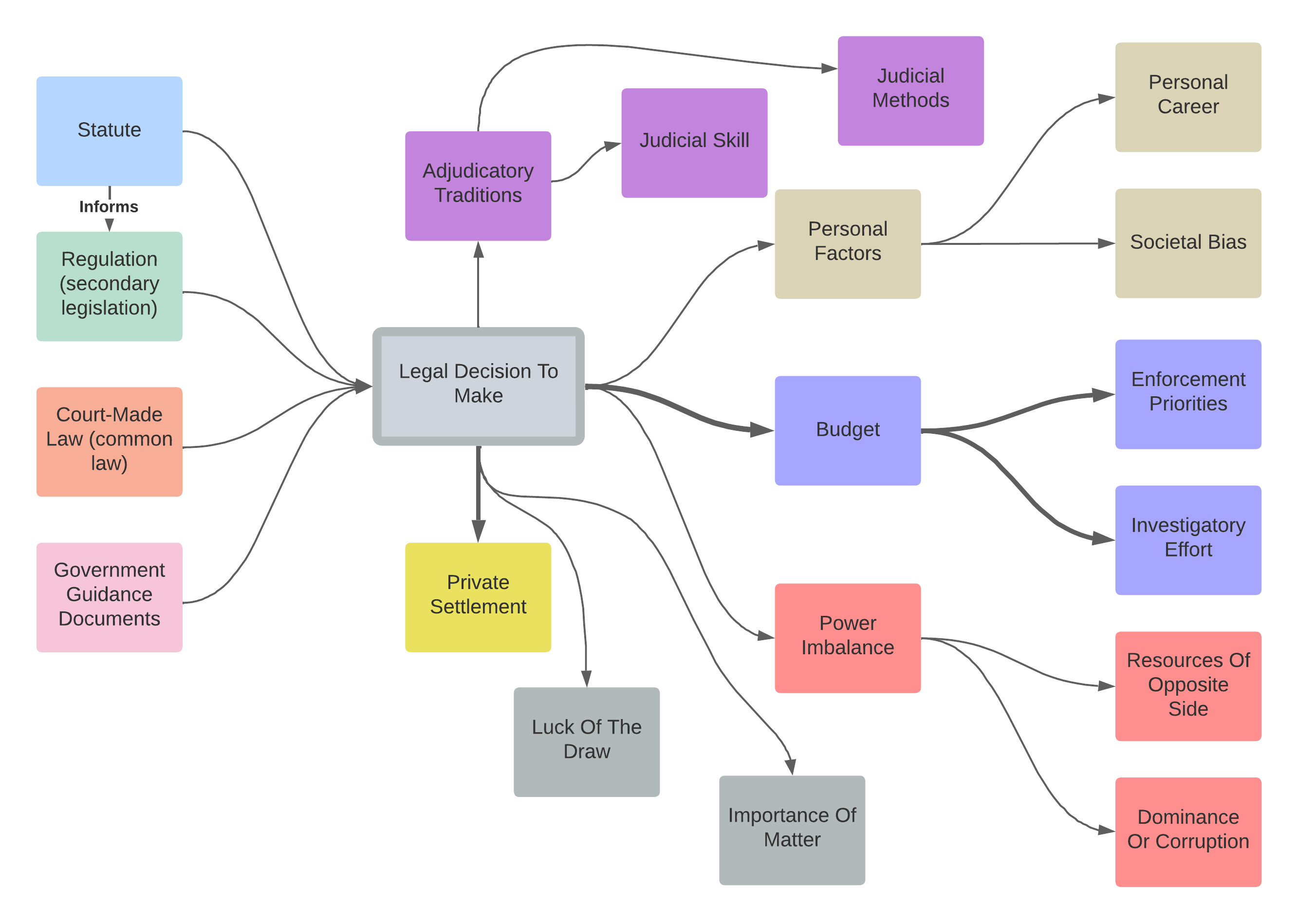
There are three assumptions widely held by the public, lawmakers, and even many lawyers. The three assumptions are, together, the FEF assumptions, which is that laws are:
Published on June 8th, 2023
There are three assumptions widely held by the public, lawmakers, and even many lawyers. The three assumptions are, together, the FEF assumptions, which is that laws are:
Published on May 12th, 2023
An alternative title for this blog post could be: “Assumptions About Law That Surprise Engineers (And Some Lawyers)”.
Published on May 8th, 2023
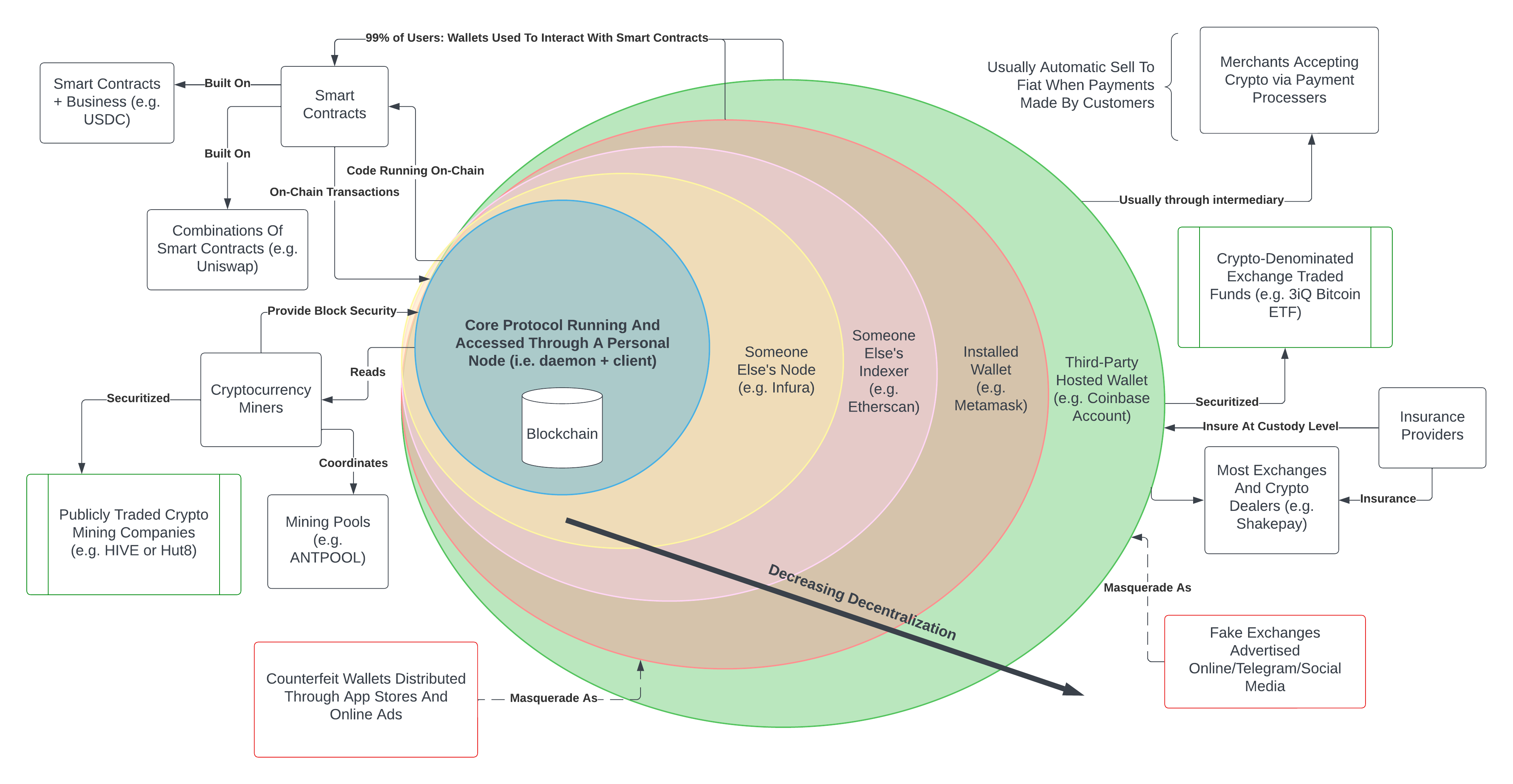
People who work in the cryptocurrency space have a good understanding of how it works, but outside of the industry, it's a bit of a muddled mystery. Above I've attempted to illustrate how it works, with progressively larger circles of less decentralization. Some parts of the industry are closely linked to the core protocols, and others, such as merchants, exchanges, and custody services, are quite a bit further away from the decentralized core of how cryptocurrency works.
Published on May 3rd, 2023
Securities laws have an almost unique structure: forbid everything and then allow action through certain exceptions. The default prohibition is found in Ontario securities laws, and the other provinces, and in America (which is the origin of Canadian securities laws, see footnote #1). Some of the exceptions are quite broad, others much more narrow. There are many, many exceptions from the general rule of prohibition. The exceptions are designed to permit the existing markets and players in the securities industry. But this is a fairly unique legal structure. Most laws have a list of what can't be done, rather than prohibiting everything and then listing what can be done. This subverts the general legal maxim that what is not prohibited is permitted.
Many people have a hard time with understanding securities laws because they turn the general rule on its head. People are much more used to a system in which certain activities are prohibited. In a sense, securities laws are like that, but the legal structure of how that's achieved is the inverse. Securities laws are not a list of what can be done but rather exceptions from the rule that all cannot be done. This gives enormous flexibility to the regulator tasked with enforcing the law but also creates uncertainty for market participants who may not be sure what they are permitted to do. Savvy market players often operate at the edge of what's permitted or not, and sometimes their activities are legalized and become a part of the standard practice (e.g. RTOs).

Published on May 2nd, 2023
Last Friday I spoke at the inaugral professional development event of the new Metaverse Bar Association. Below are my remarks adapted from that event, aimed at lawyers trying to become advisors to token projects.
Published on April 27th, 2023
Seinfeld said that he became a good comedian by writing jokes every day. He marked off each day on a calendar and made sure to do it every day, without exceptions. If there's one key to becoming good at something it's to keep doing it every day.
Try to do one useful thing a day. This maxim works as a lawyer or in any other field.
Published on April 24th, 2023
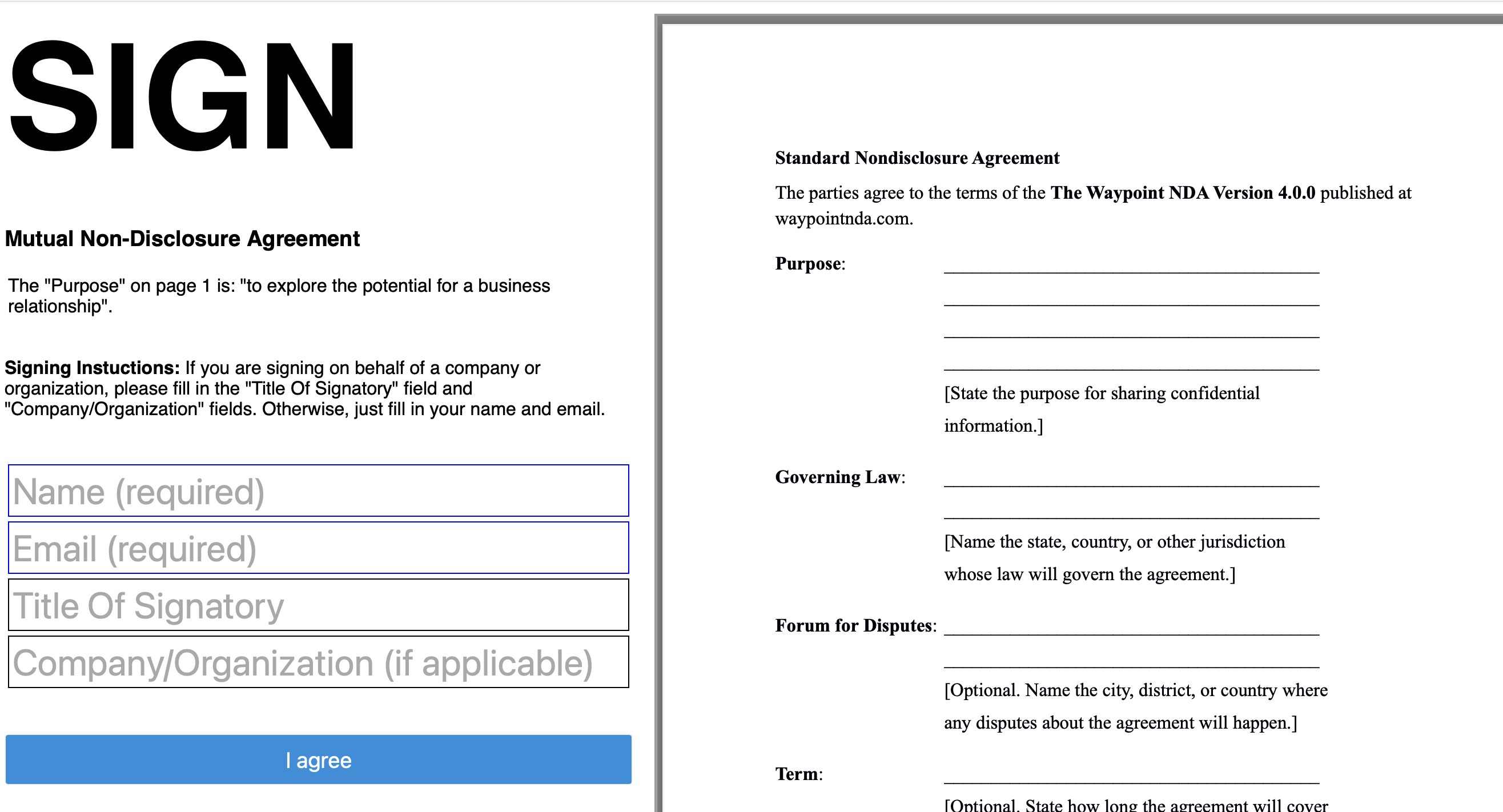
Lawyers often regard their job as being completed once they've finished writing up a contract. On the other hand, lawyers often have to deal with signing mistakes and errors that are made in making use of contracts. Docusign, and similar software, solves some of this problem but there's so much more that could be done.
Published on April 19th, 2023
Many lawyers and businesses have been discussing the idea of ChatGPT and similar LLMs taking over their work. There's a lot of promise about revolutionizing the way people work. But in reality, these tools are a very long away from replacing humans. The reason for this is that they're not good at law, they fail to properly understand questions, they fail to identify gaps in the facts that require follow up questions, and they're susceptible to making up law that doesn't exist. Below are a few examples that illustrate these problems.
Published on April 18th, 2023
This is part three of a three part series. Part one explored the business side of various crypto lenders that have gone bankrupt, and part two looked at the legal side of these companies' pre-bankruptcy operations (which reached many billions of dollars of claims). This third part looks at the CSA Staff Notice that mentions these companies and proposes new restrictions on Canadian cryptocurrency trading platforms: CSA Staff Notice 21-332 (CSAN 21-332).
For the reader who is new to these sorts of staff notices: they are a way for securities regulators to public their internal thinking about an issue. Although theoretically not law, these staff notices are often treated by practitioners as if they are law, and they're an important part of the regulatory landscape in Canada. CSAN 21-332 is complicated. This blog post looks only at the parts of the notice that are related to credit/borrowing.
Published on April 7th, 2023
The first part of this series examined the crypto lenders that took the blockchain world by storm a few years ago, and ended in several high-profile bankruptcies. This post looks at what the laws about lending are, and the arguments for why these crypto lenders weren't violating laws (despite the SEC & state-level settlements that say they were). This post completes the necessary background to understand the next part in this series, which is about the government's response in Canada to the failures of crypto lenders in the US. The first half of this article explains the background on various sorts of credit products, and then the second half gets into the specifics of the legal arguments of the now-bankrupt crypto lenders.
Published on April 4th, 2023
The image above is from section 48 of Hammurabi's Code and it concerns the delay of payment of debt due to crop failure. The Canadian Securities Administrators (CSA) issued their own document concerning debt, around 3700 years after Hammurabi. A lot has changed in the intervening years, but not the government's interest in regulating debt and credit. This blog post is a part of a series that looks at that interest in the context of the cryptocurrency industry, with particular attention to the companies mentioned in the CSA's most recent guidance document: Voyager Digital, Celsius, BlockFi and Genesis. These companies, up until they went broke, managed billions of dollars of other people's money, and promised a new world of credit for crypto. What went wrong? What were they doing? Why have regulators taken such a strong interest? Read on to learn more about what was once a popular business model.
Published on April 3rd, 2023
As economies develop and markets improve, it's natural to see the distinction between money and asset grow thinner. Bitcoin and money is a good example of this. Money market funds and bank deposit accounts is another. As transaction costs decrease, people can switch between assets in a way that's very money-like.
The thinning line between asset and money has legal practice ramifications because the blurring of categories calls for greater care in ensuring that businesses stay on the right side of laws written for a world in which the lines were thicker and more obvious.
Published on March 30th, 2023
Electronic contracts are lawful, binding, and a constant presence in our lives. At one point, contracts required “wet ink” signatures, or special stamps, or other formalities. In the modern era (or at least, in modern countries), these formalities are dispensed with in favour of ease of doing business. In Ontario, some of these rules are formalized through 23 year old legislation: the Electronic Commerce Act, 2000. Similar laws exist elsewhere to enable online business. And yet, too many people are still signing agreements. Sometimes they sign them using Docusign or similar tools, where they're electronically mimicking the wet ink signature that's not needed. Lawyers sometimes encourage this, often because of a cultural belief in formality that might make people feel better about the whole thing. We can do better.
Published on March 30th, 2023
The tallest trees are a random pattern of branches. Trees grow where the sunlight is, where the wind pulls them, and a thousand other factors that cause the random pattern of branches. This is a better pattern for life than a regimented tree where the branches all grow exactly in the same fashion, or in the same straight lines. The most efficient, and most productive, form is a mess of branches. Startups are the same. There's order in the chaos, and the results are better. But there's also a general form to trees, although they come in different kinds, and the skill is in navigating within these parameters.
Published on March 27th, 2023
ChatGPT can do quite a good job of generating routine documents. It is very good at generating SaaS legal agreements that look like the many boilerplate agreements scattered across the Internet. Below is an example prompt and the outputs from “ContractGPT”.
You can run this example yourself by signing up for a ChatGPT account with OpenAI. There have been many startups that have done this sort of work in the past, but they will be quickly eclipsed by the power of large language models like GPT4 (already available to some people).
Published on March 13th, 2023
I've been working in the blockchain space since before Ethereum started. Working on Ethereum itself was my first experience with watching an integrated team of lawyers and professionals at work, rapidly bringing forth a brand new technology product. That work began my exposure to working in interdisciplinary teams with many (much more) experienced lawyers. Even nearly ten years later, I'm rarely the most knowledgeable lawyer in the room for every issue. And that's what clients want. Teams of specialists are required for sophisticated businesses, but there also needs to be a tech-savvy lawyer at the centre of specialty counsel.
Lawyers often imagine that clients want them to be some sort of legal titan, reciting statutory excerpts and explaining dicta. There's a place for those lawyers, but what most companies need is product counsel.
Published on March 12th, 2023
We have within us the ability to generalize from a few bad examples. The ancient humans who didn't watch out for snakes or learn from someone else drowning are the ones who didn't survive. But this same instinct can cause people to over-generalize from disasters to see them around every corner. Whether that's exchange failures like FTX, Canada's own QuadrigaCX, or the many scams and disasters catalogued on web3isgoinggreat.com, it's easy to think that the crypto space is one big disaster. Many people hold this sentiment, and it's understandable. It's easy to take these disasters and translate them into the idea that the cryptocurrency space is opposed to the rule of law. I don't think that's correct.
Published on March 12th, 2023
Silicon Valley Bank (SVB) failed on Friday. With around $200 billion in assets, this is one of the largest bank failures in US history. It has particularly affected the cryptocurrency space because SVB was especially concentrated in the technology sector. At least one major stablecoin used SVB to hold a portion of their cash: USDC. Circle Internet Financial, the corporate group behind USDC, announced that $3.3 billion USD is stuck in SVB, which is currently under the control of the FDIC (US federal government).
Published on March 12th, 2023
Canada needs to get serious about fighting financial crimes. Frauds and scams cost Canadians billions of dollars a year and undermine their faith in legitimate businesses. Fraud reports keep increasing, while police clearance rates are falling (in absolute terms, and relative terms). I get many calls from people who are the victims of sophisticated criminals and I've heard their stories. Lawyers can't usually do much to help people. The police themselves are under-resourced and don't have the necessary technical resources to combat sophisticated criminals, who target Canadians from abroad.
A specialty police unit is the best means of targetting frauds. It's better in most cases than using securities regulators, consumer protection regulators, or other agencies that don't have the necessary experience and skills to take on modern criminals. The days of pickpockets are over. Canadians don't lose the $200 in their wallet. They lose their $500,000 retirement nest egg. The costs are staggering.
Published on March 12th, 2023
Bahamas-based FTX closed (spectacularly) last year, taking with it $95 million USD of investment from the Ontario Teachers' Pension Plan (OTPP), and billions of dollars of customer assets. FTX was not registered in Canada, but it was in the process of acquiring Canadian crypto dealer Bitvo, which news reports indicate was held up by pending regulatory approval. It also seems that there are reports that FTX was serving at least some Canadians but that part of their operation was murky. At some point, Ontarians were onboarded and trading on FTX, then later refused (perhaps due to action by the OSC behind the scenes - this is not explained publicly).